

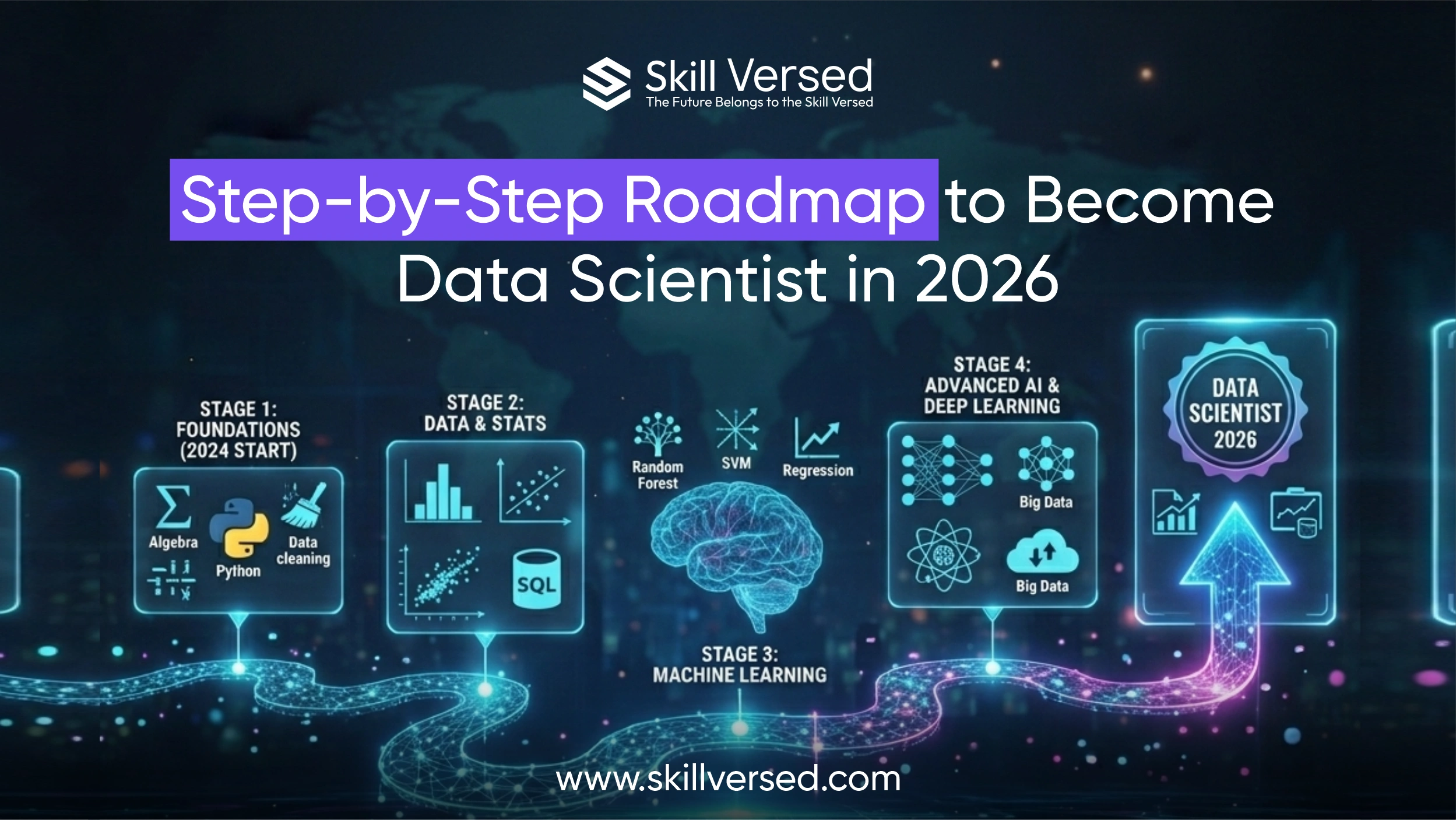
If you've been Googling" how to become a data scientist" and ending up more confused than when you started this is for you.
There is a lot of bruit out there. Courses vowing you will be job ready in 30 days. YouTube videos covering 47 tools you" absolutely need." Reddit vestments that helical into assertions about R vs Python.
Then there is the verity the data wisdom career path is really straightforward. What makes it feel convoluted is that utmost people start in the wrong order. This roadmap fixes that. It's structured around what really matters in 2026: the skills employers are renting for right now, the tools that show off in real job delineations, and a pragmatic timeline that will not burn you out. Allow's get into it.
Why 2026 is actually a great time to begin
The data wisdom field has progressed. Companies are not precisely experimenting with data presently they are deeply dependent on it. The U.S. Bureau of Labor Statistics data wisdom over 35% through 2032, which is important faster than the normal for all other occupations.
But then is what has changed employers now want people who can do the work, not precisely talk about it. instruments alone will not get you hired. A portfolio of real systems will. That is what this roadmap is structured around.
The data scientist roadmap:
Build your foundation
Before anything else, you need two non-negotiable chops: Python and SQL.
These are the languages of data wisdom. Python is your primary device for dissection, visualization, and structure models. SQL is how you will prize and manipulate data in nearly every professional terrain.
Python: Where to start Do not try to get all of Python. seat on what data scientists really exercise daily. Start with variables, circles, and places. also remove libraries NumPy for numerical missions, Pandas for data manipulation, and Matplotlib/ Seaborn for visualization.
An Ultrapractical Exercise: download a free dataset from Kaggle, cargo it in Pandas, and answer 5 questions about it utilizing law. Do this for 10 moments and your foundation will be logical.
SQL do not hop this:numerous newcomers hop SQL thinking Python is enough. That is a mistake. The utmost companies store their data in relational databases. You will need SELECT, WHERE, GROUP in, JOIN, and aggregate places as a birth. SQLiteOnline.com is free and requires zero format to exercise.
Timeline checkpoint: By the end of month 2, you should be suitable to encumber a dataset, clean it, explore it visually, and draw structured data utilizing SQL inquiries. Nobody fancy being precisely active.
Get comfortable with data
This stage is where newcomers get intolerant and spring ahead to engine literacy. repel that appetite.
Data scientists give the maturity of their time on data fighting and exploratory data dissection( EDA) not on structure models. Mastering this font is what separates a good data scientist from someone who precisely knows scikit-get.
What to concentrate on:
- Handling missing data and outliers
- Point engineering( creating new variables from being bones)
- Gathering dispensations, correlations, and patterns
- Constructing clear, readable visualizations that tell a story
Tool to append Get the basics of Jupyter Scrapbooks if you have not formerly. It's the standard issue terrain for data disquisition, and it will be what recruiter anticipate to know in your portfolio.
Learn machine learning the right way
Now you are ready for the portion everyone wants to start with.
Engine literacy is where Python actually shines. The go to archive is scikit- get, and it's freshman friendly once your Python fundamentals are logical.
Start with these algorithms:
- Linear Retrogression and Logistic Retrogression( your chuck and adulation)
- Decision Trees and Random timbers
- K- Means Clustering for unsupervised cases
More important than knowing numerous algorithms is gathering when and why to exercise each bone. Get how to estimate model interpretation utilizing criteria like delicacy, perfection, recall, and RMSE and understand what those figures really mean in the environment.
Also get
- Cortege / test crannies and cross validation
- Overfitting and how to help it
- Introductory hyperparameter tuning
Do not assail to deep literacy yet. utmost data wisdom jobs do not bear it. Prescriptive ML will get you much farther in 2026 than you suppose.
Build a portfolio and start applying
This is the stage that really gets you hired.
Your portfolio should have 3 end to end systems hosted on GitHub. Each design should tell a comprehensive story, then is the case, then is the data, then is my dissection, then are the rulings.
Good design ideas:
- A churn vaticination model utilizing a real business dataset
- An exploratory dissection of public health or profitable data with clear visual perceptivity
- A recommendation system or bracket case with proved effects
Write a pithy README for each design explaining your study process. Renting directors do not precisely want to know the law, they want to know how you suppose.
Before operations, also make sure you can:
- Explain the bias friction dicker in plain vanilla English
- Walk through your systems confidently in an interview
- Run introductory SQL inquiries without appearing anything up
The Honest Part:What Actually Slows You Down.
The roadmap is clear. The real challenge is thickness.
The utmost people who do not make it do not fail because data wisdom is too hard bitten. They fail because they switch between coffers constantly, they hop the boring foundational stuff, or they stay until they" feel ready" to make systems.You do not need to see everything. You need to see enough to break real cases and show off that in a portfolio.
Your next step right now
Do not close this tab and do nobody. Pick one thing
- Still, and run your first Jupyter Tablet, If you have not started install Python and Anaconda moment.
- If you see Python basics, pick a Kaggle dataset and do your first EDA this week.
- If you are in Stage 3 commit to finishing one end to end ML design in the coming 30 days.
The data scientist roadmap is not a riddle. It's a conclusion. Follow the conclusion, make the work, and the openings will come.
SetUp this useful? Follow for further ultrapractical, no fluff attendants on breaking up into data wisdom in 2026.